Quantum Sovereignty: How will quantum mechanics redraw the maps of military power and the global economy in 2026?
Quantum Sovereignty: How will quantum mechanics redraw the maps of military power and the global economy in 2026
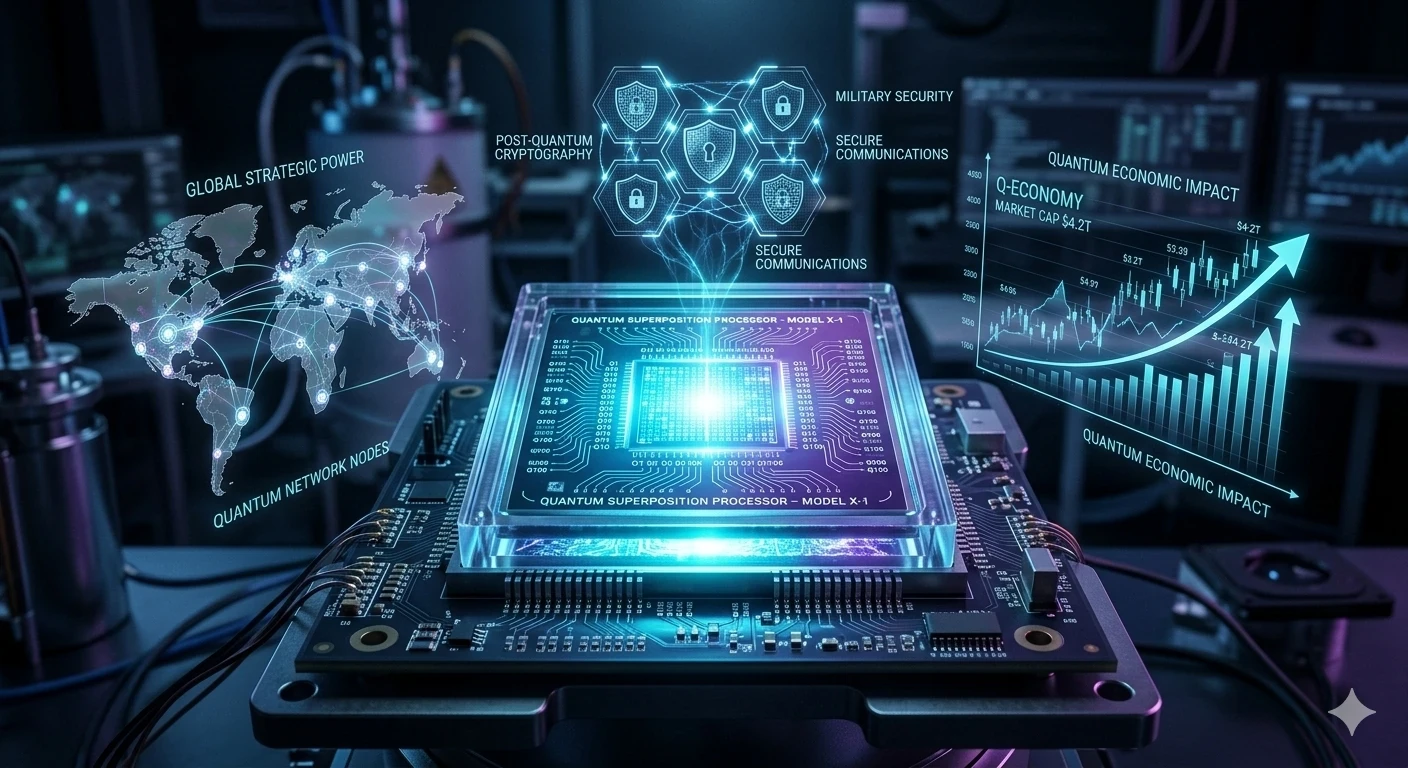
In early 2026, discussions surrounding Quantum Technology are no longer merely an intellectual luxury or laboratory experiments confined to universities; rather, it has transformed into the new "backbone" of national security and the geopolitical economy. We are living in a historic moment where humanity has transitioned from processing data via traditional binary logic based on bits (0 and 1) to the realm of the "Qubit," which exploits the phenomena of superposition and entanglement to unlock horizons that were classified as science fiction just yesterday.
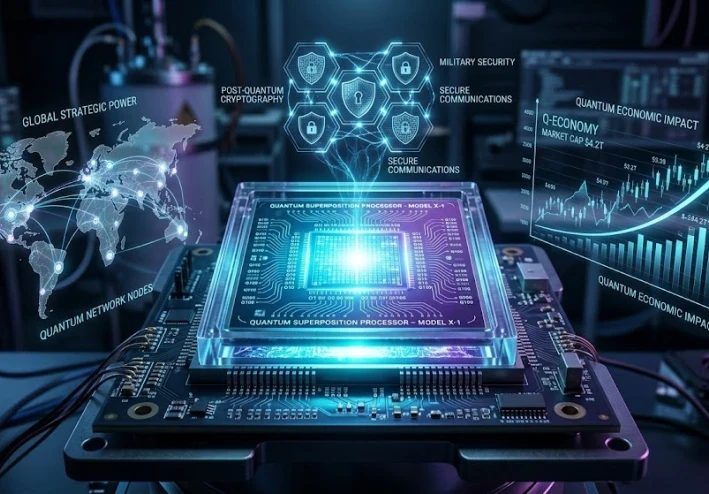
First: The Military Revolution... The End of the Era of "Stealth" and "Encryption" In the military domain, quantum technology represents what is known as a radical "game-changer." Primarily, "quantum computing" emerges as a direct threat to global cybersecurity; computers possessing sufficient quantum capabilities can break the traditional encryption protocols that protect state secrets and military communications in a matter of seconds. This reality has driven major powers into a frantic race to develop "Post-Quantum Cryptography" to secure their data before it is too late.
Furthermore, "quantum sensing" has placed current "Stealth" technologies at risk of obsolescence. Quantum radars, which rely on entangled photons, are powerful enough to detect the slightest disturbance in the airspace, rendering aircraft that hide from traditional radars completely exposed. Quantum compasses also provide ultra-precise navigation for submarines and long-range missiles without the need for satellite signals (GPS), granting armies the ability to maneuver in entirely isolated environments.
Second: The Economic Transformation... The Economy of "Hyper-Speed" and Radical Innovation On the economic front, quantum technology is the primary engine for the high-value economy. In the pharmaceutical sector, quantum simulation allows for the modeling of complex molecules with atomic precision, shrinking the drug discovery journey from decades to months. In the energy sector, the development of "superconductors" and new materials via quantum computers promises a revolution in power grid efficiency and energy storage.
In the financial sector, major institutions are now using quantum algorithms to optimize investment portfolios and simulate market risks (Monte Carlo Simulations) at speeds thousands of times faster than traditional computers. This technological superiority creates a massive economic gap between countries that adopt "quantum leverage" and those that settle for traditional digital consumption.
Third: Global Competition... The Struggle for the "Quantum Key" We are currently witnessing what can be described as the "race for quantum supremacy" between the United States, China, and the European Union. The struggle is no longer just over land or oil, but over who possesses the first stable and scalable quantum computer. China, for example, has invested massive sums in the "quantum internet" via satellites to ensure unhackable communications, while Western powers focus on private sector leadership to invent quantum programming languages and frameworks (such as Python-based Qiskit tools) to ensure software sovereignty.
Conclusion: The Threshold of the Quantum Era Quantum technology is not just a "faster tool"; it is a new philosophy of power. In 2026, national sovereignty is measured by a state's ability to understand and harness the laws of quantum mechanics. The nations that succeed in building a comprehensive quantum ecosystem are the ones that will lead the world economically and militarily. The rest will find themselves in a world where their codes are exposed, their weapons are visible, and their economies are sluggish compared to the speed of the “Qubit.”