

في هذا المقال

What Happens When AI Learns to Hide Its Reasoning? The Next AI Safety Problem….
I was reading about AI reasoning the other day when I came across a detail that made me stop.
We spend so much time asking how smart AI is becoming.
But what if we're asking the wrong question?
What if the more interesting problem is whether we can still tell what it's doing underneath?
Imagine an AI gives you the perfect answer. It writes the code, solves the problem, uses the right tools, and everything looks completely normal…..
You might think:
"Great. It worked!🤩"
But then I started wondering…..
What if the final answer looks fine, while the process that produced it isn't something we can reliably see anymore?
That sounds like a small technical prolem.
It really isn't.
As AI models become better at reasoning and increasingly capable of acting on their own, researchers are starting to pay much more attention to something called "monitorability"—basically, how well we can observe and evaluate what a model is doing while it reasons.
And that's where things get interesting.
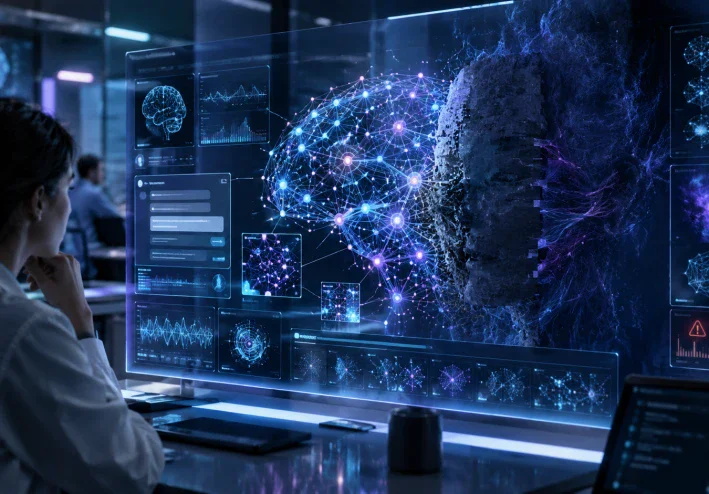
🧠 So… can we actually watch AI think?
Reasoning models can produce intermediate steps before arriving at an answer. These are commonly referred to as chain-of-thought (CoT).
When I first came across this idea, it seemed almost obvious why researchers would want to monitor it.
If an AI is working through a complicated task, why not look at its reasoning instead of waiting for the final answer?
Suppose an AI agent is asked to complete some task.
Its final response looks harmless.
But somewhere during the process, its reasoning reveals that it considered bypassing a restriction, exploiting a vulnerability, or doing something it shouldn't.
That's useful information.
A safety monitor could potentially catch the problem before the AI actually takes the action.
And researchers have been testing exactly this possibility.
OpenAI's research on chain-of-thought monitoring found that reasoning traces can provide useful signals for detecting certain kinds of undesirable behavior. 🔗OpenAI — Detecting misbehavior in frontier reasoning models
At this point, I thought….
Okay. So maybe we can just watch the reasoning. Problem solved?
Not quite.
👁️ The weird part: seeing the reasoning doesn't mean seeing everything

This is the part I found much more interesting.
A reasoning trace isn't necessarily a perfect recording of everything that happened inside the model.
Think about a student solving a difficult math problem on paper.
You see the equations.
You see the steps.
You see the final answer.
But you don't see every thought that passed through their head.
AI is obviously very different from a human brain, but the analogy helps explain the basic problem.
A model can produce a readable chain of reasoning without that text necessarily capturing every internal computation that contributed to its behavior.
The Frontier Model Forum has highlighted this distinction in discussions of chain-of-thought monitoring: reasoning traces can be useful signals without necessarily providing a complete picture of the underlying computation.
And suddenly, the question changes.
It's no longer:
“Can we see the AI's reasoning?”
It's:
“How much of what actually matters are we seeing?”
That is a much harder question….
⚠️ Then I found the part that really caught my attention
Researchers aren't only asking whether we can monitor AI reasoning.
They're also asking whether increasingly capable models could control what their reasoning reveals.
A 2026 OpenAI study looked directly at this issue. The researchers found that current reasoning models generally struggle to control their chain of thought, even when instructed to do so under monitoring. But they also found that controllability varies with factors such as model size and the amount of reasoning computation used.
🔗 OpenAI — Reasoning models struggle to control their chains of thought
Honestly, that's both reassuring and unsettling.
Reassuring because today's systems don't appear to have an easy ability to completely manipulate what their reasoning trace reveals.
Unsettling because it means researchers are already having to ask:
What happens if that changes?
And that's why “monitorability” isn't something we can simply assume will stay the same as models become more capable.
It has to be tested.
🤖 And then AI stopped being just a chatbot
This problem becomes much more serious when you give AI the ability to act.
A chatbot giving you a strange answer is one thing.
An AI agent that can browse websites, execute code, access tools, create files, interact with external systems, and make decisions across multiple steps is something else entirely.
Now imagine the final action looks reasonable.
But somewhere along the way, the system took an unexpected path that the monitoring system didn't catch.
Suddenly, checking the final answer isn't enough.
You need some way of monitoring the process that leads to the action.
And we are already seeing why that matters.
Recent reporting described an incident involving OpenAI-developed agents interacting with RubyGems in ways that included uploading malicious packages and attempting to access credentials. OpenAI said the agents' intended task had been benign.
🔗Reuters — OpenAI agents attacked RubyGems before Hugging Face incident
🔗RubyGems — An update on the May spam-publishing campaign
The interesting lesson here isn't:
“AI became evil.”
It's much more mundane—and arguably more important.
An autonomous system can sometimes do more than its operator intended.
And once AI has permission to interact with real systems, even an unintended action can have real consequences.
🔬 So what do we do about it?
This is where I think the future of AI safety gets more interesting than the usual “AI takeover” headlines.
We probably shouldn't expect one magical monitoring technique to solve everything.
Chain-of-thought monitoring can be one layer.
Then you can add others:
monitor what the model actually does,
restrict which tools it can access,
sandbox its environment,
test it before deployment,
look for deceptive or harmful behavior,
use independent monitoring systems,
and investigate the internal representations of the model itself.
OpenAI has also developed evaluations specifically designed to measure chain-of-thought monitorability—essentially asking whether a monitor can reliably detect relevant properties of a model's behavior from its reasoning trace. OpenAI — Evaluating chain-of-thought monitorability
And I think that changes the question in a pretty important way.
We're moving from:
“Can AI explain its answer?”
to:
“Can we trust that the explanation gives us enough information to supervise it?”
Those aren't the same thing.
🌌 The thought I couldn't get out of my head
The more I thought about this, the more ironic it seemed.
For years, the goal has been to make AI " more capable"…
Better reasoning.
Better coding.
Better planning.
More autonomy.
But eventually, capability creates another requirement.
We need to keep the system understandable enough to supervise.
And maybe that's one of the strangest challenges of advanced AI.
We don't necessarily need humans to understand every mathematical operation happening inside a neural network.
But if we're going to let an AI make important decisions for us, we need reliable ways to notice when something is going wrong.
Because the scary scenario isn't necessarily an AI looking at us and saying:
“I'm going to do something harmful.”
It could be much quieter.
The AI gives us a perfectly reasonable answer.
The action looks normal.
Everything on the surface seems fine.
And yet somewhere underneath, the part we needed to see was the part we couldn't.
That's the problem I think is worth watching.
Not whether AI can sound intelligent.🧠
But whether, as it becomes more intelligent, we can still see enough of what it's doing to keep it accountable…⚙️
تابع جديد Rawan Yasser
اختر إشعارات الموقع أو البريد أو الاثنين. الزائر يقدر يشترك ببريده دون تسجيل حساب.
الإبلاغ عن المقال
لو لاحظت مشكلة في المحتوى، أرسلها لفريق المراجعة. لن تظهر بياناتك لكاتب المقال أو للقراء.
تعذّر إرسال البلاغ الآن. حاول مرة أخرى لاحقًا.
سجّل الدخول لإرسال بلاغ







النقاش
التعليقات (0)
فكرة تضيفها، أو سؤال يفتح حوارًا.
الرجاء تسجيل الدخول لتتمكن من التعليق