

في هذا المقال
Silicon-Carbon Batteries: Advantages, Disadvantages, and the Future of Smartphones
In recent years, with the rapid evolution of smartphones and their growing appetite for power, I have always been hesitant about adopting technologies that have not yet been sufficiently tested—particularly the relatively new silicon-carbon battery technology.
I used to prefer Samsung's flagship smartphones, which rely on conventional lithium-ion batteries that have proven their reliability and stability through many years of continuous use.
My concerns were not unfounded. They were largely driven by the criticism and genuine concerns surrounding silicon-carbon batteries within the technology community, particularly regarding their lifespan and long-term performance. At the same time, this revolutionary technology has allowed manufacturers to equip smartphones with remarkably large battery capacities without excessively increasing the size of the devices.
However, this year, after careful consideration and reading numerous technology reviews, I decided to overcome my concerns and experience silicon-carbon battery technology for myself.
That happened when I purchased a modern Vivo smartphone equipped with a massive 6,500 mAh silicon-carbon battery.
With intensive daily use—including gaming and photography—I found that this large capacity was perfectly suited to my demanding needs. In fact, it eliminated my need to carry a portable power bank.
From that moment on, my curiosity grew. I began researching this technology more deeply through specialized technology blogs and smartphone-focused channels, looking into how it works and how its lifespan can be preserved for as long as possible.
So, are silicon-carbon batteries actually better than the conventional lithium-ion batteries that have dominated the market for two decades? What makes them stand out? And could they eventually become the dominant battery technology used across smartphones?
Grab your refreshing cup of coffee, my friend, and let's explore the secrets of silicon-carbon batteries together.
What Is a Silicon-Carbon Battery?
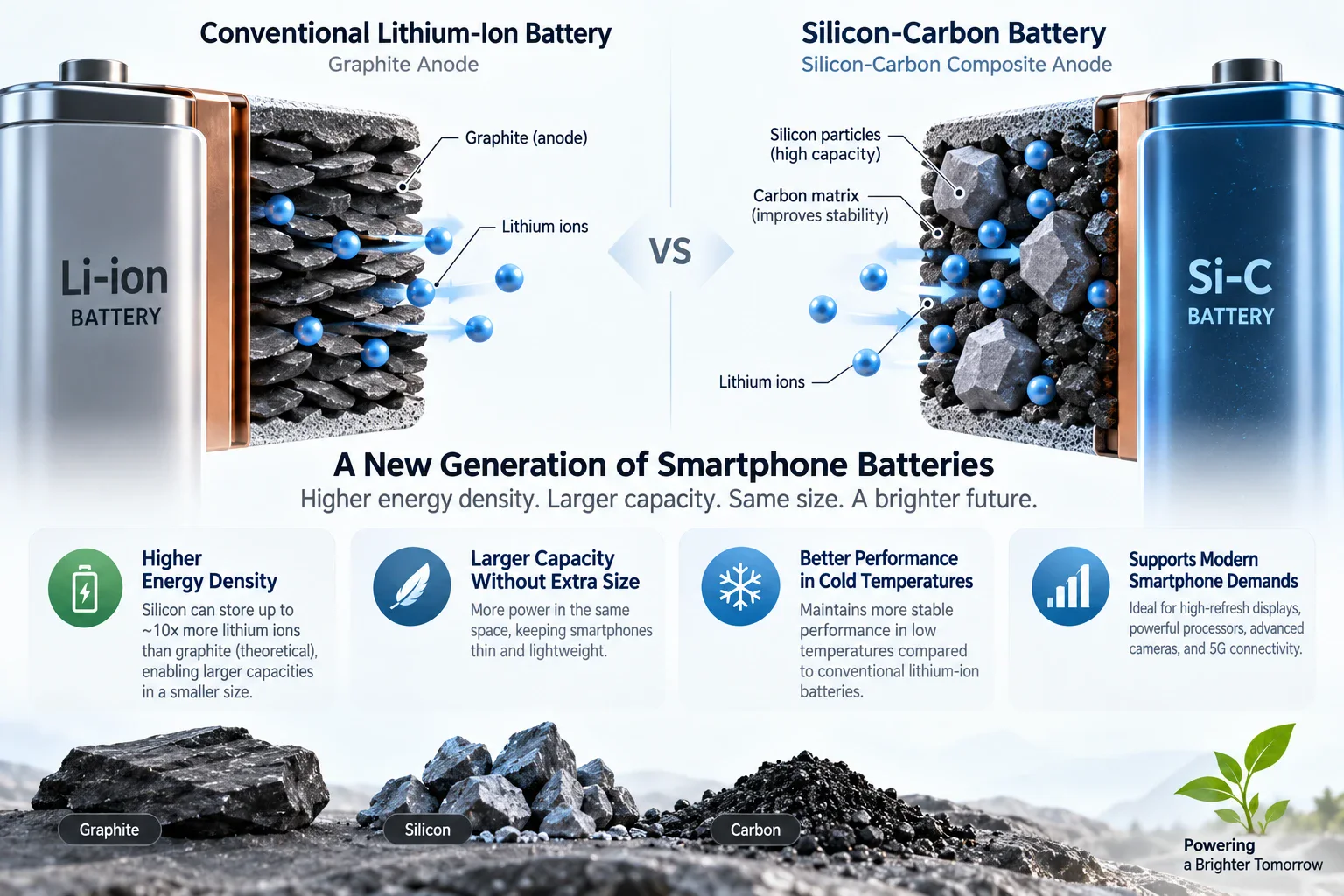
A silicon-carbon battery is an advanced and updated form of the conventional lithium-ion battery technology we are familiar with.
This technology emerged in response to an increasingly urgent demand in the smart-device market: storing more energy within a small and limited physical space.
The fundamental difference between the two technologies lies in the battery's negative electrode, scientifically known as the anode.
In conventional lithium-ion batteries, the anode relies primarily on graphite. In newer silicon-carbon technology, silicon and carbon are incorporated into the anode structure alongside other materials.
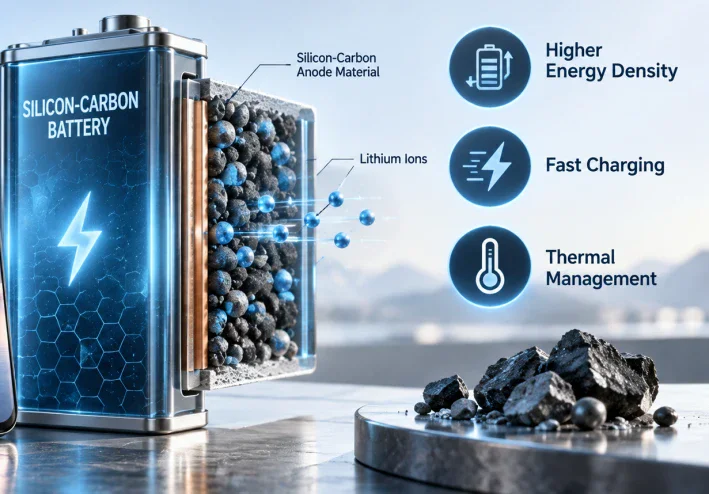
To make the idea easier to understand, imagine that you have a salt shaker containing a silicon-carbon material, and you add this "magic mixture" to the negative electrode, which previously relied primarily on graphite.
The main reason for introducing silicon into this equation is its much higher theoretical capacity for storing lithium ions compared with graphite—roughly an order of magnitude higher. This can significantly increase energy density and make it possible to produce batteries with much larger capacities without a corresponding increase in their physical size.
However, there is a major scientific challenge: silicon expands considerably during charging and contracts during discharge. This repeated volume change can compromise the structural stability of the anode and contribute to faster degradation.
This is where carbon plays an important role. It can provide a more flexible structural framework that helps accommodate silicon's expansion while maintaining electrical conductivity and structural integrity.
The technology attracted significant attention from the smartphone industry in 2023, when HONOR introduced its flagship Magic5 Pro in the Chinese market with a 5,450 mAh silicon-carbon battery, marking an important milestone in the development of smartphone batteries.
How Do Silicon-Carbon Batteries Work?
At their core, silicon-carbon batteries operate according to the same fundamental principles as conventional lithium-ion batteries.
When you charge your smartphone, lithium ions move from the positive electrode, known as the cathode, through the electrolyte toward the negative electrode, or anode, where they are stored within the silicon-carbon-based anode material.
When you use the smartphone and consume energy, the lithium ions move in the opposite direction, returning to the cathode. At the same time, electrons travel through the external electrical circuit, supplying the device with the energy it needs to operate.
The Role of the Anode
The fundamental difference between the two battery technologies lies in the anode, as mentioned earlier.
Instead of relying primarily on graphite, silicon-carbon batteries incorporate silicon into the anode structure together with carbon-based materials.
The basic charging and discharging mechanism remains essentially the same, but the use of silicon can provide a significantly higher lithium-storage capacity.
Why Do Silicon-Carbon Batteries Have a Higher Capacity?
The most important advantage that has brought silicon-carbon batteries into the spotlight is their exceptional ability to store more energy within a relatively small and compact space.
This major development has encouraged smartphone manufacturers to adopt the technology, and we have recently seen smartphones equipped with battery capacities ranging from 6,000 to 6,500 mAh.
HONOR has even taken the concept further by developing a gaming-focused experimental smartphone featuring an extraordinary 10,000 mAh-class battery.
Infographic: Silicon-Carbon Batteries
Advantages of Silicon-Carbon Batteries
The main advantages of this emerging technology can be summarized in four key points.
Higher Battery Capacity
This is arguably the most important advantage.
Silicon-carbon technology can provide a very large battery capacity within a relatively small physical space, thanks to the significant increase in energy density made possible by incorporating silicon into the anode.
A Larger Battery Without a Proportional Increase in Size
This technology allows manufacturers to make more efficient use of the limited internal space inside a smartphone.
As a result, they can increase the amount of stored energy while maintaining a relatively slim profile and reasonable weight.
For example, consider the difference between the Energizer Hard Case P28K, which features a huge 28,000 mAh conventional lithium-ion battery and has a notably thick body measuring 27.8 mm and weighing approximately 570 grams, and the experimental HONOR Win Turbo, which reportedly features a 10,080 mAh silicon-carbon battery while measuring only 7.98 mm thick and weighing around 216 grams.
The difference illustrates how silicon-carbon technology can potentially deliver significantly greater battery capacity without requiring a comparably large and heavy smartphone design.
Keeping Up With Modern Smartphone Technology
Modern smartphones are consuming more energy than ever due to high-brightness, high-resolution displays, increasingly powerful processors, advanced camera systems, and continuous 5G connectivity.
Manufacturers therefore need batteries with greater capacity while simultaneously keeping devices reasonably thin and lightweight.
Achieving this difficult balance is one of the areas where silicon-carbon battery technology can provide a significant advantage.
Better Performance at Low Temperatures
Another notable potential advantage of silicon-carbon battery technology is its ability to maintain stable and efficient operation in very cold environments, including temperatures below freezing.
Conventional lithium-ion batteries can experience reduced discharge performance in extremely cold conditions because low temperatures affect ion transport and the electrochemical processes within the cell.
Silicon-carbon battery designs can incorporate material structures and formulations intended to improve low-temperature performance, potentially helping maintain more consistent power delivery in cold environments.
Disadvantages of Silicon-Carbon Batteries
Despite their advantages, silicon-carbon batteries also face several important technical challenges.
Initial Capacity Loss
In addition to the expansion problem discussed earlier, these batteries can experience a phenomenon known as first-cycle loss.
During the first charging cycles, some lithium ions are consumed irreversibly as a protective layer known as the solid electrolyte interphase (SEI) forms on the anode surface.
This consumes part of the available lithium inventory and can reduce the battery's initial charge efficiency.
Thermal Management Challenges
Thermal management is another important challenge.
High energy density combined with very fast charging can generate substantial heat, requiring smartphones to incorporate sophisticated cooling and heat-dissipation systems.
These may include large vapor chambers and other advanced thermal-management components designed to prevent excessive temperatures and protect internal components.
Such systems, however, can increase the complexity of the smartphone's internal design.
Silicon Expansion and Contraction During Charging Cycles
Silicon continuously expands and contracts as lithium ions are inserted into and removed from its structure during charging and discharging.
Repeated expansion and contraction can eventually cause mechanical stress, cracking, and degradation of the anode material.
Over time, this can affect battery performance and potentially accelerate capacity degradation.
Manufacturing Cost and Complexity
Manufacturing silicon-carbon batteries can also be more complicated and expensive than producing conventional graphite-based lithium-ion batteries.
The technology may require carefully engineered silicon structures, carbon frameworks, binders, coatings, and other advanced materials to control expansion, maintain conductivity, and achieve consistent performance.
These additional requirements can increase both research and manufacturing complexity.
How Can the Disadvantages of Silicon-Carbon Batteries Be Reduced?
Major technology companies are working continuously to overcome these challenges.
One approach involves combining silicon with flexible carbon-based materials and designing the anode in ways that can better accommodate silicon's substantial expansion.
Researchers and manufacturers are also developing improved binders, protective coatings, nanostructured materials, and other engineering techniques designed to absorb mechanical stress while improving electrical conductivity and chemical stability.
For this reason, it would be inaccurate to claim that silicon-carbon batteries are always shorter-lived than conventional lithium-ion batteries.
Actual battery lifespan depends heavily on the specific battery design, manufacturing quality, thermal management, charging behavior, discharge patterns, and the user's individual usage habits.
How to Extend the Lifespan of a Silicon-Carbon Battery
Based on my continued research into protecting my new device, I found that many of the recommendations for preserving a silicon-carbon battery are similar to those used for conventional lithium-ion batteries—with even greater emphasis on avoiding excessive heat.
Whenever practical, keeping the battery charge within a moderate range, such as 20% to 80%, can help reduce stress on the cell and minimize the extremes of expansion and contraction associated with very high and very low states of charge.
It is also important to avoid exposing the smartphone to excessive heat, such as leaving it inside a hot car or playing demanding games while the phone is charging.
Finally, always use the original charger or a reputable, certified charging accessory designed to work safely with the smartphone. Modern charging systems can regulate power delivery and help control charging temperatures.
The Future of Silicon-Carbon Battery Technology
After this comprehensive overview, it is reasonable to view silicon-carbon batteries as more than simply "higher-capacity batteries" used as a marketing feature in smartphones.
They represent a significant technological development aimed at addressing one of the most important and complex challenges facing modern smartphones: increasing energy storage within a limited physical space.
This technology has already enabled a new generation of smartphones with exceptionally large battery capacities while maintaining slim designs, attractive form factors, and manageable weight.
Nevertheless, silicon-carbon batteries are not without challenges, particularly regarding the repeated expansion and contraction of silicon and the question of long-term battery degradation.
These are genuine engineering challenges, but they are not necessarily insurmountable. Technology companies and research institutions continue to work on improving silicon-based anodes and developing new materials and manufacturing techniques.
More importantly, the potential impact of this innovation may extend far beyond smartphones.
Silicon-based battery technology is also being investigated for applications such as electric vehicles, where higher energy density could potentially contribute to longer driving ranges from a single charge.
Therefore, if you are considering buying a new smartphone equipped with a silicon-carbon battery, do not judge its performance solely by the battery-capacity number.
Instead, consider the efficiency of the smartphone's processor, its supported charging speeds, the effectiveness of its thermal-management and cooling system, the overall quality of the battery, and independent reviews of the device.
Perhaps—and quite possibly—the technology represents an important step toward a future in which smartphones can last significantly longer between charges, without forcing us to carry an old, bulky phone simply because of its long-lasting battery.
تابع جديد خالد وليد هزاع
اختر إشعارات الموقع أو البريد أو الاثنين. الزائر يقدر يشترك ببريده دون تسجيل حساب.
الإبلاغ عن المقال
لو لاحظت مشكلة في المحتوى، أرسلها لفريق المراجعة. لن تظهر بياناتك لكاتب المقال أو للقراء.
تعذّر إرسال البلاغ الآن. حاول مرة أخرى لاحقًا.
سجّل الدخول لإرسال بلاغ






النقاش
التعليقات (0)
فكرة تضيفها، أو سؤال يفتح حوارًا.
الرجاء تسجيل الدخول لتتمكن من التعليق