
In this article
The World of Software: The Hidden Engine of Digital Evolution
In recent decades, the world has witnessed a massive technological revolution that has radically reshaped human life. At the heart of this revolution, "software" stands as the hidden engine and the soul that breathes life into physical hardware. Without software, computers and smartphones would be mere pieces of metal and plastic with no practical value. Software is essentially a meticulously arranged set of instructions and codes that tells the hardware how to operate and directs it to execute specific tasks.
Software varies greatly to cover all human needs, and it can be fundamentally divided into three main types. First, System Software, led by operating systems such as Windows, Android, and Linux; it acts as the translator and mediator between the user and the device components. Second, Application Software, which includes programs that users interact with directly to perform specific tasks, such as internet browsers, office suites, video games, and social media applications. Third, Programming and Development Software, which consists of the tools and compilers that developers use to write and build new software.
The importance of software is evident in its high efficiency and ability to automate complex processes. In the business sector, accounting and management software have helped reduce time, effort, and human errors to a minimum. In education, digital learning platforms have opened new horizons for knowledge, transcending geographical boundaries. In healthcare, medical analysis and disease diagnosis software have helped save millions of lives and improve the quality of medical care provided to patients.
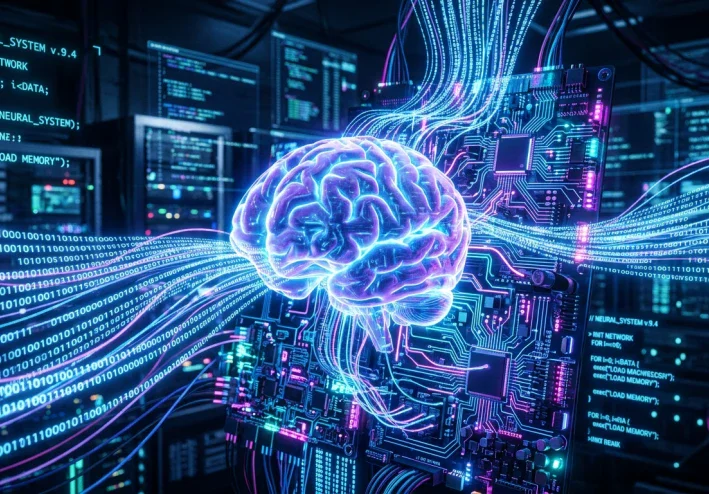
With the current acceleration of knowledge, the software world is undergoing a historical turning point driven by Artificial Intelligence (AI) and Machine Learning. Programs are no longer just rigid lines of code executing fixed commands; they have become intelligent entities capable of learning, adapting, and predicting user behavior. Today, smart software drives autonomous vehicles, manages global power grids, and provides personalized recommendations to individuals based on their preferences.
In conclusion, software is no longer just an auxiliary technological tool; it has become the core infrastructure upon which the modern world is built. Understanding how this software works and develops is the only way to keep pace with the future and contribute to shaping it. Software is the language in which humanity is writing the story of its next technological triumph.
- Smart Defense: Using machine learning algorithms to predict attacks, analyze network behavior, and detect threats before they occur.
- Automated Attacks: Attackers exploiting AI to develop malware capable of evading detection and automatically altering its code.
- Data Falsification: Protecting systems against data poisoning attacks that aim to mislead and compromise AI models.
Zero Trust Architecture
- Elimination of Implicit Trust: Never trusting any user or device by default, even if they are inside the institution's internal network.
- Continuous Verification: Periodically and repeatedly checking identity, device health, and geographic location throughout a single session.
- Network Segmentation: Dividing the network into small, isolated segments to prevent an attacker from accessing the rest if one part is breached.
Section 4: Cloud & Supply Chain SecurityCloud Security
- Shared Responsibility: Understanding the distribution of security duties between the cloud provider (like infrastructure) and the hosting organization (like data and access).
- Identity and Access Management (IAM): Precise configuration of cloud account permissions to avoid sensitive data leaks over the internet.
- Container Security: Protecting virtual development environments like Docker and their orchestration tools like Kubernetes.
Software Supply Chain Security
- Third-Party Components: Scanning open-source packages to ensure they are free of backdoors.
- Software Bill of Materials (SBOM): Creating an official, detailed inventory of all components and tools used in building the software to easily track vulnerabilities.
- CI/CD Pipelines Security: Protecting build and automated deployment servers to prevent the injection of malicious code during application updates.
Section 5: Incident Response & ComplianceIncident Response Plan
- Detection and Analysis: Rapidly identifying the breach, determining the scope of damage, and identifying the affected data types.
- Containment and Isolation: Immediately disconnecting infected systems from the network to prevent the threat from spreading to other servers.
- Recovery and Lessons Learned: Restoring data from secure backups and updating policies to patch the discovered vulnerability.
Security Compliance
- Personal Data Protection: Complying with global and local regulations to protect user privacy, such as GDPR.
- Payment Card Industry Data Security Standard (PCI-DSS): Applying strict requirements to secure electronic payment gateways and store credit card data.
- Security Certifications (ISO 27001): Adopting standard frameworks to professionally manage information security within organizations.
Report this article
Tell our review team about a problem with this content. Your details will not be shown to the author or other readers.
Your report could not be sent. Please try again later.
Sign in to report an article








Discussion
comments (0)
Share a perspective. Start a thoughtful conversation.
please login to be able to comment