
In this article
What Are Business Automation and Artificial Intelligence?
 Business automation is the use of software and digital systems to perform tasks that would otherwise require manual effort. These tasks may include sending emails, recording customer information, preparing reports, processing orders, and scheduling appointments.
Artificial intelligence, on the other hand, focuses on developing systems that can perform tasks commonly associated with human abilities, such as understanding language, recognizing images, learning from data, analyzing information, and helping solve problems.
Although the two concepts are closely related, they are not interchangeable. Traditional automation generally follows predefined rules: when a particular condition is met, the system performs a specified action. AI-powered systems can go further by interpreting different types of information, identifying patterns, and generating predictions or content.
When the two technologies work together, businesses can build workflows that do more than follow fixed instructions. They can automate routine actions while using AI to help interpret information and determine what should happen next.
How Did Artificial Intelligence Begin?
Although AI has become increasingly visible in everyday life in recent years, its scientific foundations date back to the middle of the twentieth century.
In 1950, British mathematician Alan Turing published his influential paper, Computing Machinery and Intelligence. Rather than treating machine intelligence as a purely abstract question, Turing explored whether a machine could imitate human conversation well enough to challenge our ability to distinguish it from a person. This idea became associated with what is now known as the Turing test.
A major milestone followed in the summer of 1956, when researchers gathered at Dartmouth College in the United States for a research project dedicated to artificial intelligence. The workshop is widely regarded as a foundational event in the establishment of AI as an academic field. The term artificial intelligence was introduced in this research context and is credited to researcher John McCarthy.
Progress, however, was far from straightforward. Early researchers faced limited computing power, insufficient data, and the challenge of translating complex human abilities into mathematical rules and computer programs.
Over time, improvements in computing hardware, the growing availability of digital data, and advances in algorithms opened new possibilities. Machine learning and deep learning helped systems identify patterns in increasingly complex datasets. More recently, generative AI has brought new capabilities, including drafting text, summarizing documents, generating images, and assisting with software development.
This history reveals an important point: modern AI is not the result of a single breakthrough. It has developed through decades of research, experimentation, and improvements in computing technology.
How Does Artificial Intelligence Work?
To understand AI, it helps to look beyond the technical terminology and focus on the basic process.
Many AI systems begin with data. Depending on the task, this may include text, images, audio recordings, numerical information, or records of business transactions. Algorithms and mathematical models are then used to identify patterns and relationships within that information.
In machine learning, a model is trained using examples so that it can learn patterns relevant to a particular task. When new information is presented, the trained model uses those patterns to produce an output, such as a prediction, classification, recommendation, or response.
Generative AI works differently from a simple rule-based system. It learns statistical patterns from training data and uses them to generate new content, including text, images, and code. However, generating a convincing response does not guarantee that the response is accurate. AI systems can misunderstand a request, produce misleading information, or fail when faced with situations that differ from their training experience.
For that reason, human oversight remains important, particularly when decisions involve money, sensitive information, customer rights, or business risks. AI is most useful when its capabilities are matched with appropriate checks and a clear understanding of its limitations.
How AI and Business Automation Work Together
The real value of combining AI with automation becomes clearer when we examine a practical business scenario.
Consider an online store that receives hundreds of customer messages every day. In a traditional workflow, an employee may need to read every message, identify its purpose, record relevant details, and forward it to the appropriate department.
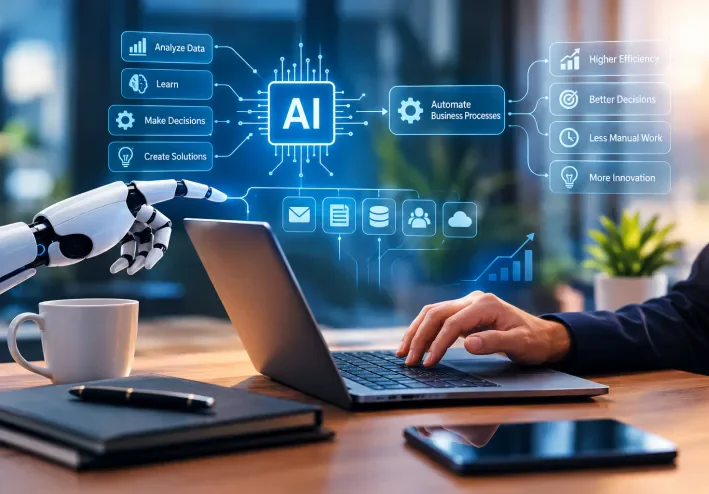
With AI-powered automation, a system could analyze incoming messages, classify them as questions, complaints, or return requests, extract important information, and record that information in a customer management system. It could then prepare a suitable draft response.
Routine cases could follow an automated process, while unusual or sensitive situations could be referred to a human employee. This approach can reduce manual work, improve consistency, and help staff respond more efficiently without removing human judgment from important decisions.
The same principle applies to many other organizations, including service providers, educational institutions, marketing agencies, and companies that manage large volumes of transactions or documents.
Key Applications of AI and Business Automation
Customer service: Businesses can classify incoming messages, answer common questions, direct requests to the appropriate department, and escalate complex cases to employees.
Marketing and sales: AI can help analyze customer interactions, organize leads, prepare content drafts, and support follow-up activities.
Administration and operations: Automated workflows can prepare recurring reports, organize documents, update databases, and send notifications when specific conditions are met.
Finance and accounting: Systems can extract information from invoices, categorize transactions, and flag unusual activity for further review.
E-commerce: Businesses can automate order updates, organize product information, analyze customer feedback, and use historical data to support demand planning.
The results depend on several factors, including data quality, the suitability of the technology, and how well the solution integrates with existing business systems.
The Benefits for Modern Businesses
One of the main advantages of automation is the reduction of time spent on repetitive tasks. Instead of manually entering the same information or preparing identical reports, employees can focus on activities that require communication, creativity, judgment, and problem-solving.
Automation can also make processes more consistent, improve information availability, and help organizations track work more effectively. AI adds another layer of value by analyzing large collections of information, identifying patterns, and assisting with tasks involving complex documents or unstructured data.
These advantages should not be confused with a guarantee of success. A poorly designed workflow can make a business process more complicated rather than more efficient. Technology creates value when it solves a clearly defined problem and improves a measurable business outcome.
Challenges Businesses Need to Consider
AI and automation also introduce risks that organizations should not ignore.
AI-generated information may be inaccurate, and model outputs can reflect biases present in training data. Poor data quality can reduce the reliability of results, while careless handling of customer records or confidential business information can create privacy and security concerns.
Implementation can also involve costs, integration difficulties, and the need to train employees. In addition, excessive reliance on automated decisions can become a problem when a system encounters an unfamiliar situation or makes an error.
Businesses should therefore establish clear rules for data access, privacy, system permissions, and human approval. New solutions should be tested on a limited scale before wider deployment, with regular monitoring to identify problems and improve performance.
How to Get Started with Business Automation
Organizations do not need to begin with a large, expensive AI project. A better starting point is often a small, repetitive task that consumes a noticeable amount of time, such as entering invoice details, sorting incoming requests, or preparing a weekly report.
The next step is to map the existing process and identify delays, unnecessary steps, and common errors. A suitable automation tool can then be selected. If the task requires interpreting language, classifying documents, or analyzing unstructured information, AI may provide additional value.
The solution should be tested using measurable indicators, such as processing time, error rates, operating costs, and service quality. If the results meet the intended goals, the workflow can be expanded gradually. Continued monitoring and human oversight help ensure that the system remains useful as business needs evolve.
Conclusion: The Future of Business Is About More Than Technology
Business automation and artificial intelligence are changing the way organizations approach everyday work. Automation can handle recurring processes, while AI can help interpret information, recognize patterns, and support a wider range of tasks.
Still, adopting the latest technology is not an achievement in itself. The real objective is to choose the right tools, solve meaningful problems, protect sensitive information, and measure whether the results justify the investment.
AI does not eliminate the need for human judgment. Instead, when implemented thoughtfully, it can give people more time to focus on decisions, relationships, and work that requires experience and creativity.
Perhaps the most important question is no longer, “What can artificial intelligence do?” It is, “How can we use it to build businesses that are more efficient, adaptable, and responsible?”.
References
Alan Turing, Computing Machinery and Intelligence, Mind, 1950: https://academic.oup.com/mind/article/LIX/236/433/986238
Dartmouth College, The Founding and Future of AI: https://ai.dartmouth.edu/our-story
IBM, What Is Artificial Intelligence (AI)?: https://www.ibm.com/think/topics/artificial-intelligence
McKinsey, The State of AI: How Organizations Are Rewiring to Capture Value, 2025: https://www.mckinsey.com/capabilities/quantumblack/our-insights/the-state-of-ai-how-organizations-are-rewiring-to-capture-value
Keep up with ahmed alawady
Choose site notifications, email, or both. Guests can subscribe by email without an account.
Report this article
Tell our review team about a problem with this content. Your details will not be shown to the author or other readers.
Your report could not be sent. Please try again later.
Sign in to report an article






Discussion
comments (0)
Share a perspective. Start a thoughtful conversation.
please login to be able to comment