"Beyond the Screen: How Gaming is Reshaping Human Consciousness and the Global Economy"
“Beyond the Screen: How Gaming is Reshaping Human Consciousness and the Global Economy”
In past decades, video games were viewed as a side activity reserved for children or teenagers in their closed rooms. Today, as we live in the heart of the hyper-digital revolution, gaming has bared its teeth to prove that it is the most influential force shaping human culture and the global economy. We are not talking about mere entertainment here, but a massive industry whose profits surpass those of the movie and sports sectors combined, setting the rules for what the future of humanity will look like.
The Technological Revolution: Gaming as a Lab for the Future
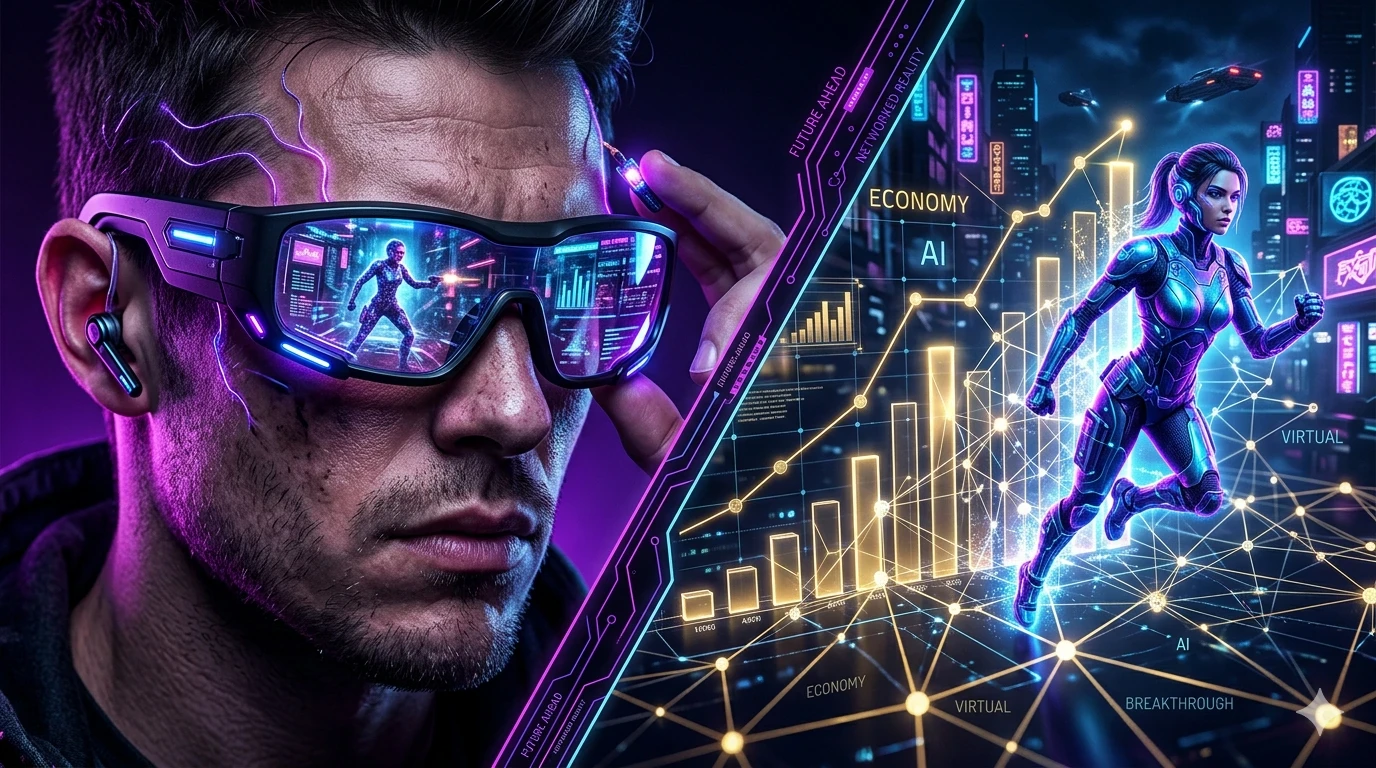
If you want to know where technology is heading in the next ten years, don't look at traditional research labs; look at game engines. The technologies that have recently changed our world—from generative AI to 3D virtual worlds and ultra-cloud computing—were originally developed and refined to serve the gaming community.
Today, thanks to the integration of advanced AI into games, we are no longer facing pre-programmed characters with limited options. Non-Player Characters (NPCs) now possess an "artificial consciousness" that allows them to make dynamic decisions based on player behavior, making every gaming experience completely unique and personalized.
Social Connections and Positive Escapism
Gaming has redefined the concept of "community." In a world suffering from digital isolation, virtual worlds have turned into public squares where millions of people from different cultures and backgrounds meet. Games are no longer just "games"; they have become platforms for attending live music concerts, holding business meetings, and building cross-continental friendships.
This constant interaction grants players what psychologists call "positive escapism"—it is not an escape from responsibility, but a safe space to develop leadership skills, complex problem-solving, and teamwork under pressure. Strategic games and Role-Playing Games (RPGs) place the player in situations that require critical thinking and quick wit that vastly outperform what is taught in traditional educational systems.
The "Play-to-Earn" Economy and Financial Professionalism
On the economic side, a massive boom has occurred. The concept of gaming is no longer limited to paying money to buy a game; it has transformed into an integrated economy that relies on a two-way financial flow. Through electronic sports (E-Sports), which fill stadiums with thousands of fans and millions more behind screens, the "player" has turned into a professional athlete earning millions of dollars from sponsorships and prizes. Furthermore, gaming economies built on digital assets and AI have opened doors for new job opportunities, where millions earn their living by designing virtual worlds or trading within games.
The New Reality
Gaming is the fine art of the 21st century; it combines the storytelling of a novel, the visual beauty of cinema, and the vital interaction that no other media medium provides. We are not heading towards a tomorrow where gaming plays a role in our lives; we are already living in a reality where gaming is the axis around which the next human evolution revolves. The question now is no longer, "Why do you play?", but rather: "How will gaming shape your future?".