The Era of Agentic AI: Shifting from Interaction to Autonomous Execution
 The Era of "Agentic AI": The Shift from Interaction to Execution in 2026
The world today is no longer what it was three years ago. In 2026, we are living in a pivotal moment in technological history, having moved past the fascination with text-based "chatbots" to enter a new era known as "Agentic AI." This transition is not merely an evolution in software; it is a fundamental redefinition of how work and daily tasks are accomplished, both on a personal level and within major corporations in global innovation hubs.
What makes 2026 distinct?
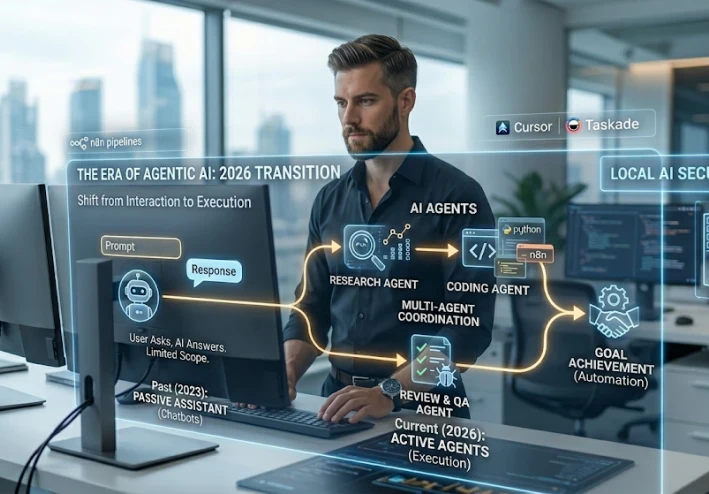
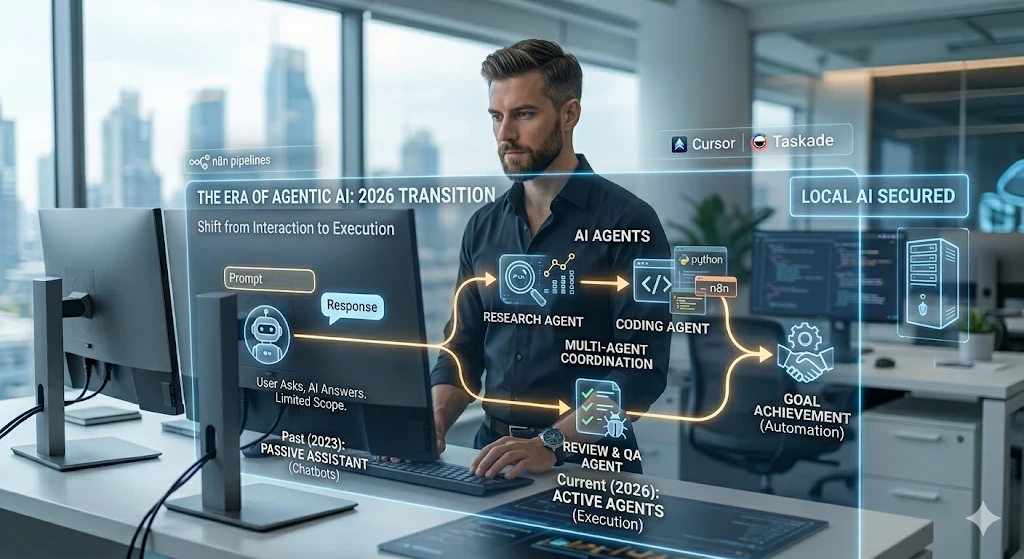
In previous years, most AI tools acted as "passive assistants"—you would ask, and they would answer. Today, these tools have transformed into "active agents." An AI Agent is a system that does not just provide information; it possesses the capability to make decisions and execute multi-step processes to achieve a final goal.
For instance, if you ask an AI today to organize a meeting, it will not just draft an email for you; it will connect to your calendar, message the other parties, determine the most suitable time for everyone, and send out meeting links—all without any intervention from you beyond the initial prompt. This type of intelligent automation is what Silicon Valley refers to as “proactive automation.”
Multi-Agent Systems
One of the biggest trends occupying the minds of programmers and technologists in 2026 is Multi-Agent Systems. Instead of relying on a single AI model to handle everything, the trend has shifted toward building "digital task forces." Imagine a team consisting of three agents: one specialized in research and data collection, another in coding, and a third in review and debugging. These agents coordinate with one another, deliberate, and correct each other's errors to reach the optimal result. This technique is what currently enables companies to reduce software development time by staggering margins.
The Move Away from the Cloud: The "Local AI" Revolution
With the increasing reliance on AI, there are significant concerns regarding data privacy and the costs of hosting massive models on the cloud. In 2026, the shift toward "Local AI" has become a powerful trend. Individuals and companies now prefer to run intelligent models directly on their own hardware (high-spec PCs or local servers). This approach not only eliminates high monthly subscription costs but also ensures the security of sensitive data, making it the preferred choice for professionals and organizations that prioritize privacy.
How to prepare for this era?
If you are asking for the path to success in this rapidly accelerating technical landscape, the answer lies in "Workflow Redesign." The required skill is no longer "how to write a good prompt"; it is "how to design a system that connects tools together." Programmers and creators today are those who possess the ability to build "pipelines" that link tools like n8n, Taskade, and Cursor to create fully automated workflows.
Conclusion
We are not talking about mere auxiliary tools to make life easier, but a fundamental change in the structure of human production. Agentic AI frees humans from repetitive and tedious tasks, opening the door for greater creativity in fields that require strategic thinking and deep meaning. If you want to be at the forefront of this movement, do not just observe AI from afar; start integrating "agents" into your next project, and learn how to make the machine work for you, rather than just with you.