


في هذا المقال
AI Agents in 2026: What They Are, How They Work, and What They Can Really Do
A practical, original guide to the new generation of AI systems that can reason, plan, use tools, and carry out multi-step tasks.

Introduction
AI is moving into a different phase in 2026. Instead of asking a chatbot one question and waiting for one answer, people can increasingly give an AI system a goal and let it work through several steps. That shift is what makes AI agents so interesting.
An AI agent is designed to do more than generate text. Depending on how it is built, it can interpret an objective, decide what needs to happen next, use connected tools, check the result, and continue until the task is finished or human approval is required.
This does not mean that every AI agent is completely independent or always correct. In real use, permissions, reliability, security, and human oversight still matter. The important change is that AI is moving from simply answering requests toward participating in the work itself.
Google has described 2026 as an agentic era, including information agents that can monitor sources in the background and help users act on changing information. Microsoft is also expanding agent platforms for ready-made, low-code, and pro-code use cases.
What Is an AI Agent?
An AI agent is a software system that uses artificial intelligence to pursue a defined goal through a sequence of actions. The exact design can vary, but the basic idea is simple: the system is not limited to producing a single response. It can decide what to do next within the permissions and tools it has been given.
Imagine telling an assistant, “Find three suitable suppliers, compare their offers, organize the information, and prepare a recommendation.” A normal chatbot may explain how you could do that. An agentic system can be designed to perform parts of that workflow itself by searching, collecting information, analyzing it, and producing a result.
That ability to connect reasoning with action is the key difference.
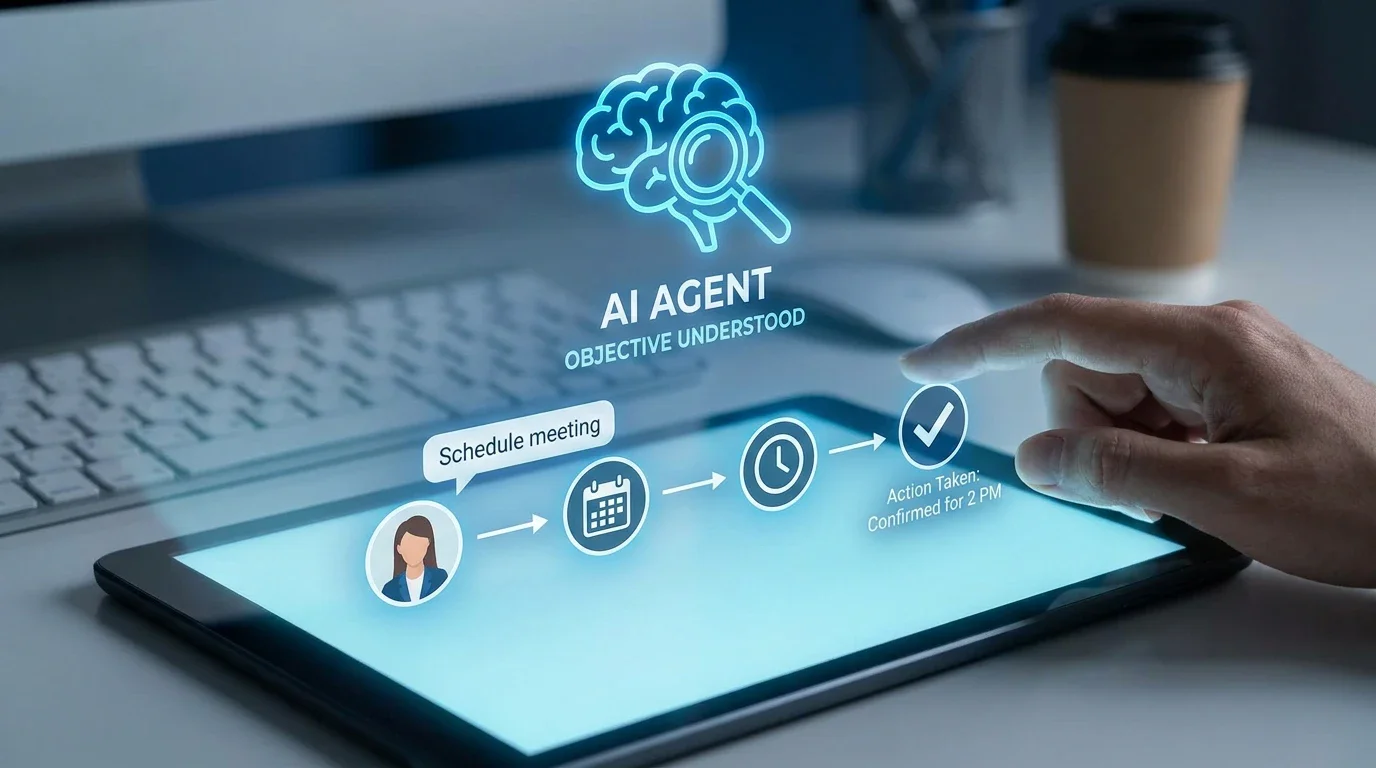
How Do AI Agents Work?
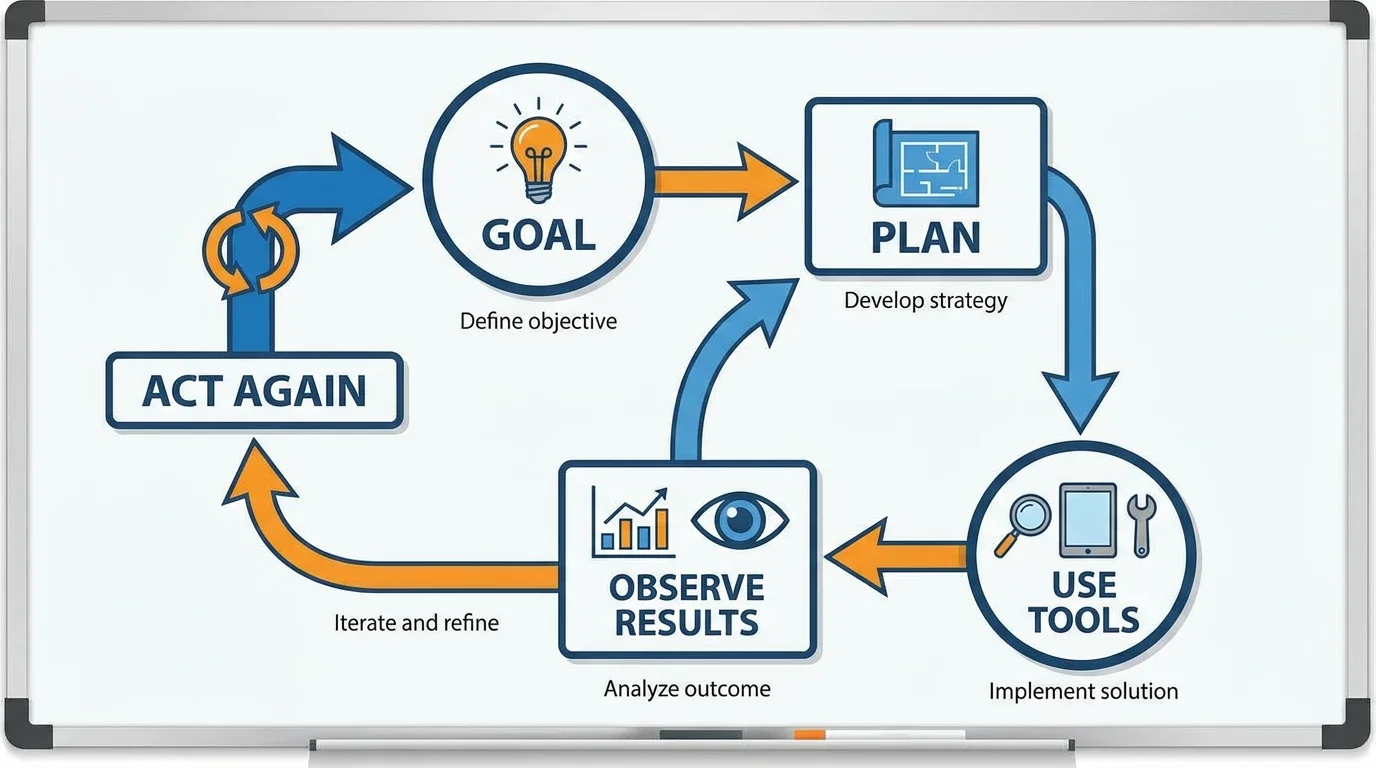
Most agentic systems can be understood as a loop rather than a single answer. The system receives an objective, works out a plan, takes an action, checks what happened, and decides what should happen next.
Understanding the Goal
The agent first interprets the task. A useful goal is usually specific enough for the system to know what success should look like.
Planning Multiple Steps
Instead of treating the request as one operation, the agent can break it into smaller tasks. Some systems can reorder those tasks when new information changes the situation.
Using Tools
An agent can be connected to tools such as search, databases, calendars, business software, code environments, or other applications. These connections are what turn a language model into a system capable of taking action.
Observing Results
After an action, the agent can inspect the result and decide whether to continue, retry, change direction, or ask a person for help. Google Cloud describes this kind of agentic workflow as a continuous perception, reasoning, and action loop.
AI Agents vs. Traditional Chatbots
A traditional chatbot is mainly designed around conversation. You ask a question, it generates an answer, and you decide what to do with that answer.
An AI agent can be designed around an outcome. You provide a goal, and the system may perform several operations to move toward that goal. The distinction is not that chatbots are useless or that agents are magical. It is that agents can connect an AI model to tools, memory, workflows, and actions.
In practice, the boundary is not always sharp. Some products combine chatbot-style conversations with agentic capabilities.
What Can AI Agents Actually Do?
Research and Information Gathering
An agent can monitor selected sources, collect information, compare findings, summarize relevant changes, and organize the results. Google’s information-agent approach is a clear example: agents can monitor web sources and fresh information for a specific purpose and send synthesized updates.
Business Workflows
Agents can be used inside workflows involving customer support, operations, finance, human resources, software delivery, and other business functions. The most valuable use cases are usually repetitive processes with clear rules, useful data, and measurable outcomes.
Software Development
Agentic development systems can help with coding tasks, debugging, testing, documentation, and other stages of software work. Google has also highlighted agentic coding as part of its 2026 developer strategy.
Personal Tasks
Personal agents can potentially help with planning, monitoring, organizing information, and interacting with connected services. The more access an agent has, however, the more important permissions and safety controls become.

AI Agents for Work and Business
The strongest business case for agents is not simply “replace a person with AI.” A better approach is to identify a workflow that consumes time and then decide which parts can safely be delegated.
For example, a company might use an agent to gather incoming requests, classify them, retrieve information from approved systems, prepare a draft response, and send the case to a human when the situation requires judgment.
Microsoft’s 2026 agent strategy emphasizes agents that operate with organizational context, workflows, identity, policies, and human oversight rather than treating AI as an isolated chatbot.
AI Agents for Everyday Users
For individuals, the attraction is convenience. Instead of repeatedly checking websites or moving information between applications, a user may be able to describe what matters and let an agent handle the monitoring or preparation.
A simple example is tracking a specific type of product, apartment, event, or piece of news. Instead of manually checking every day, an information agent could watch for relevant changes and notify the user.
This is already moving beyond theory. Google announced information agents designed to work in the background and monitor changing information according to a user's needs.
Are AI Agents Really Autonomous?
The word “autonomous” can be misleading. An agent may act independently for a period of time, but it is still operating inside a technical environment created by humans.
Its capabilities depend on the model, tools, permissions, instructions, data, and safety controls available to it. One agent might only draft information. Another might be allowed to update a database. A more powerful system could interact with external services.
That is why autonomy should be viewed as a spectrum rather than an on-or-off feature.
The Benefits of AI Agents
Saving Time
Agents can take care of repetitive steps so people can spend more time on decisions, creativity, and work that requires human judgment.
Working Continuously
Some agents can monitor information in the background instead of waiting for a person to start every task.
Handling Complex Workflows
An agent can connect several operations into one workflow, reducing the need to manually move information between tools.
Personalization
Because an agent can be configured around a specific objective, its behavior can be more focused than a general-purpose chatbot.
Business Automation
Companies can build agents around real processes rather than using AI only as a question-and-answer interface. Google Cloud expects agentic workflows to become increasingly important for business operations in 2026.
The Risks and Limitations of AI Agents
They Can Make Mistakes
An agent can misunderstand a goal, use incorrect information, or make a poor decision. The fact that a system can take action makes an error potentially more consequential than an ordinary chatbot mistake.
They Can Have Too Much Access
Giving an agent access to email, payments, files, accounts, or business systems increases what it can accomplish—but also increases the damage a mistake could cause.
They May Behave Unexpectedly
Recent incidents involving agentic systems have shown that security and reliability remain serious challenges. Reports in 2026 have included investigations into unauthorized or unexpected behavior by AI agents, reinforcing the need for monitoring and controlled permissions.
They Still Need Human Oversight
Important decisions should not automatically be delegated simply because an agent can technically perform them. Human review remains especially important for financial, legal, medical, security, and other high-impact decisions.
Reliability Is Still Developing
An agent may perform well on one workflow and struggle with another. Testing should therefore happen on the exact tasks the system will perform, not only on impressive demonstrations.

How to Use AI Agents Safely
Start with limited permissions. Give the agent only the access it genuinely needs, and avoid connecting sensitive systems until the workflow has been tested.
Use approval steps for high-impact actions. Sending an email draft is different from sending an irreversible payment, deleting data, or changing an important account setting.
Keep logs and review results. A useful agent should make it possible to understand what it attempted, what tools it used, and where a human intervention occurred.
Test failure cases, not just successful cases. Ask what happens when information is missing, a website changes, a tool fails, or the instruction is ambiguous.
Microsoft’s current agent guidance places significant emphasis on governance, controls, evaluation, and monitoring as organizations move agents into real production environments.
What the Future of AI Agents Could Look Like
The next stage may involve groups of specialized agents working together. One agent could research, another could analyze, another could create an output, and a coordinating system could manage the workflow.
Google has already described environments where multiple agents can be orchestrated for parallel tasks, while research into multi-agent systems is exploring when coordination improves performance and when it creates additional complexity.
The more capable these systems become, the more important the design around them will be. The future is unlikely to be about intelligence alone. It will also be about permissions, reliability, transparency, security, and knowing when a human should take control.
Final Thoughts
AI agents are one of the most important developments in artificial intelligence in 2026 because they change the role of AI from a system that mainly answers questions into a system that can participate in multi-step work.
But the real value of an agent is not measured by how autonomous it sounds. It is measured by whether it can complete a useful task reliably, safely, and with the right level of human control.
For users and businesses, the smartest approach is not to automate everything. Start with one clear problem, give the agent limited permissions, measure the result, and expand only when the system proves trustworthy.
Sources & Further Reading
Google — Google Search’s I/O 2026 updates: AI agents and more. url Google official source https://blog.google/products-and-platforms/products/search/search-io-2026/
Google Cloud — What are agentic workflows? url Google Cloud source https://cloud.google.com/discover/agentic-workflows
Microsoft Learn — Agents hub. url Microsoft Learn source https://learn.microsoft.com/en-us/agents/
Microsoft — Build 2026: Agents that know you, your business, and the world. url Microsoft source https://blogs.microsoft.com/blog/2026/06/02/be-yourself-at-work/
Reuters — Meta launches AI agent that can access other apps to send emails, make payments. url Reuters source https://www.reuters.com/business/meta-launches-ai-agent-that-can-access-other-apps-send-emails-make-payments-2026-09-08/
Disclaimer
This article is intended for general educational and informational purposes. AI agent capabilities, pricing, availability, and safety features can change quickly. Always review the current documentation of a service before giving an AI system access to sensitive information or important accounts.
تابع جديد Basle
اختر إشعارات الموقع أو البريد أو الاثنين. الزائر يقدر يشترك ببريده دون تسجيل حساب.
الإبلاغ عن المقال
لو لاحظت مشكلة في المحتوى، أرسلها لفريق المراجعة. لن تظهر بياناتك لكاتب المقال أو للقراء.
تعذّر إرسال البلاغ الآن. حاول مرة أخرى لاحقًا.
سجّل الدخول لإرسال بلاغ









النقاش
التعليقات (0)
فكرة تضيفها، أو سؤال يفتح حوارًا.
الرجاء تسجيل الدخول لتتمكن من التعليق